
What Parents Should Look for in a Child-Friendly School Environment
Choosing a school is about more than comparing academic results, fees, or facilities. Parents also want to know how their child will feel after walking through the school gates each morning. Will they feel safe? Can they approach their teachers when they need help? Will they have opportunities to play, create, ask questions, make friends, and develop confidence?
A child-friendly school environment should give students enough space to learn at their own pace while also providing structure, guidance, and care. When visiting a school, parents should look beyond attractive buildings and focus on the everyday experience children are likely to have there.
What Makes a School Environment Child-Friendly?

A child-friendly school environment is one where students are treated with respect and encouraged to participate in school life. It should support academic learning while also making room for physical activity, creativity, friendships, curiosity, and personal responsibility.
Parents can get a better understanding of this environment by observing how students behave around teachers, whether children appear comfortable asking questions, and how the school responds when a student needs additional support.
A welcoming atmosphere does not necessarily mean that a school has fewer rules. Children need boundaries, but those boundaries should be clear, fair, and appropriate for their age.
1. Safety Should Come First
Safety is one of the first things parents should consider. This includes physical safety on campus as well as the way the school handles student behaviour and concerns.
During a school visit, parents can ask about:
Campus security and visitor procedures
Supervision during breaks and activities
Transport safety
Emergency procedures
First-aid and medical support
Anti-bullying measures
Safe use of sports and activity areas
Parents should also observe whether students seem relaxed when moving around the campus. A school can have excellent infrastructure, but children also need to feel secure within that space.
2. Look at How Teachers Interact With Students

Teachers influence a child’s school experience every day. Parents should therefore pay attention to the relationship between teachers and students.
A positive classroom usually allows students to ask questions, make mistakes, and seek clarification without feeling embarrassed. Teachers should be able to maintain discipline while still treating students fairly.
Parents can ask:
How does the school support students who need extra academic help?
How are classroom behaviour concerns handled?
How frequently do teachers communicate with parents?
How does the school identify students who may need additional support?
The answers can reveal a great deal about the school’s approach to children.
3. Check Whether Children Feel Comfortable Asking Questions
Good learning is not limited to listening and memorising information. Children need opportunities to ask why, explore different answers, and discuss ideas.
When visiting a classroom, notice whether students are actively participating or simply listening. Ask how teachers encourage discussions, projects, experiments, presentations, and other forms of participation.
A child-friendly school environment should make curiosity welcome. A student should not feel that asking a question is a sign of weakness.
4. Consider Emotional Support and Student Well-Being
Children can experience academic pressure, friendship problems, homesickness, changes in confidence, or difficulties adjusting to a new environment.
Parents should ask how the school supports students during such situations. Depending on the school, support may include class teachers, counsellors, house parents, mentors, or other trained staff.
For younger children especially, the transition into a new school can take time. A supportive school recognises this instead of expecting every child to adjust immediately.
5. Look Beyond Academics
Academic performance matters, but it is only one part of a child’s education.
Parents should also look at the opportunities available for:
Sports
Music
Art
Drama
Public speaking
Clubs
Competitions
Community activities
Leadership
Outdoor learning
These experiences can help children discover interests that may not become visible through regular classroom lessons.
6. Check Sports, Outdoor Activities, and Play Opportunities
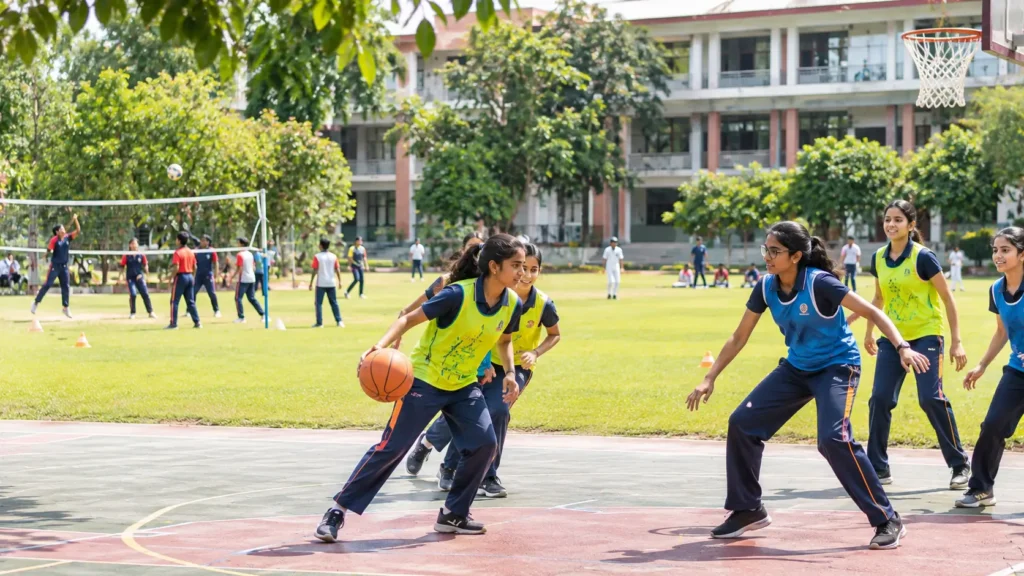
Regular physical activity is important for growing children. Parents should check whether students have meaningful opportunities to participate in sports, games, exercise, and outdoor activities.
Rather than simply checking whether a school has a large playground, ask how often students actually use the available facilities.
For younger children, play is also an important part of learning. Older students may benefit from organised sports, athletics, adventure activities, and outdoor programmes.
7. Look for Opportunities to Explore Creativity
Children do not all express themselves in the same way. Some enjoy drawing, while others prefer music, theatre, writing, design, or making things with their hands.
A child-friendly school environment gives students opportunities to explore these interests without making every activity about competition or grades.
Parents can ask whether creative activities are available throughout the academic year or only during annual events.
8. Consider Practical and Experiential Learning
Children often understand a concept better when they can see or experience it.
Science experiments, educational visits, projects, demonstrations, nature walks, exhibitions, model-making, and community activities can give students opportunities to connect classroom knowledge with real situations.
Parents should ask how frequently students participate in these activities and whether they are connected to what children are learning in class.
9. Pay Attention to Cleanliness and Basic Facilities
Small details can tell parents a lot about a school’s daily environment.
During a visit, look at:
Classrooms
Washrooms
Drinking-water facilities
Dining areas
Sports spaces
Library
Laboratories
Common areas
Medical facilities
Residential areas, if applicable
Clean and well-maintained facilities contribute to students’ comfort. Parents should also consider whether facilities are suitable for the age group and number of students using them.
10. Ask About Parent-School Communication
Parents should know how they will receive updates about their child’s academic progress, attendance, behaviour, activities, and general well-being.
Communication can happen through parent-teacher meetings, school portals, emails, notices, phone calls, or other systems.
The important question is not how many communication channels a school has, but whether parents can reach the appropriate person when they have a genuine concern.
11. Look for Opportunities to Build Independence
School is also a place where children gradually learn to take responsibility for themselves.
Age-appropriate responsibilities can include organising their belongings, completing assignments, participating in group tasks, taking leadership roles, managing schedules, and making decisions.
This can be particularly relevant when parents are considering residential education. Children living away from home need guidance, but they also need opportunities to become more independent.
12. Check Whether Technology Is Used Sensibly
Technology can make lessons more interactive, but more technology does not automatically mean better education.
Parents should ask how digital tools are being used and whether technology supports the learning objective.
A sensible approach may combine digital resources with books, discussions, practical activities, outdoor experiences, writing, and face-to-face interaction.
The goal should be to use technology where it adds value rather than using screens simply because they are available.
What Should Parents Observe During a School Visit?
A school visit can provide information that a brochure or website cannot.
Parents can use this simple checklist:
Do students appear comfortable and engaged?
Do teachers speak respectfully to students?
Are children encouraged to ask questions?
Are classrooms orderly without feeling overly restrictive?
Are sports and activity areas being used?
Are common areas clean?
Do students have opportunities to interact with one another?
Can staff clearly explain how they support students who need help?
Does the school explain its discipline policies openly?
Are parents given clear ways to communicate with teachers?
Does the campus feel suitable for the child’s age and personality?
Parents should also trust their observations. A short conversation with a teacher or student can sometimes reveal more about daily school life than a long list of facilities.
Choosing a School That Supports the Whole Child
When comparing schools, parents may come across descriptions such as top boarding school in India. However, a label alone should not determine the decision. It is equally important to understand the values and educational approach that shape a child’s everyday experience. For example, parents can learn more about how value-based education can influence discipline, responsibility, respect, and personal development by exploring Value-Based Education at Chinmaya Vidyalaya Nauni.
Conclusion
Choosing a school is an important decision, and parents should look beyond academic results and impressive infrastructure. A genuinely child-friendly school environment can be seen in everyday details: how teachers speak to students, how children participate in lessons, how concerns are handled, and whether students have opportunities to learn beyond textbooks.
Before making a decision, parents should visit the campus, ask direct questions, observe student interactions, and consider whether the school’s approach matches their child’s needs.
The best choice is not necessarily the school with the longest list of facilities. It is the school where a child can feel safe, respected, curious, active, and comfortable enough to grow.