Screen Time Rules in Boarding Schools: What Parents and Students Should Know
Technology has become an essential part of modern education. From online assignments and digital classrooms to smartphones and social media, students interact with screens in many ways throughout the day. While technology makes learning more accessible, excessive screen usage can sometimes affect students’ concentration, sleep routines, physical activities, and social interactions.
For parents considering residential education, understanding Screen Time Rules in Boarding Schools is an important part of choosing the right institution. Parents often wonder whether students are allowed to keep smartphones, how frequently they can contact their families, and whether internet access is supervised.
Boarding schools approach these concerns differently. Some restrict personal mobile phones, while others provide scheduled access to digital devices. Most importantly, the objective should be to create a healthy balance between technology, academics, recreation, and personal development.
In this guide, we explore how boarding schools manage digital access, why screen time policies matter, and what parents should ask before enrolling their children.
1. Why Screen Time Management Is Important in Boarding Schools
A boarding school provides an environment where students follow structured daily routines. Their day generally includes academic classes, supervised study periods, sports, extracurricular activities, meals, and personal time.
Without reasonable boundaries, excessive entertainment-related screen usage can interfere with these activities. This is why many residential schools establish technology guidelines.
Here are some important reasons why screen time management matters.
Better Academic Concentration
Frequent notifications, social media updates, and mobile games can interrupt study sessions. Students may find it difficult to maintain attention when they constantly switch between academic work and entertainment.
Limiting unnecessary device usage allows students to concentrate on classroom lessons, homework, reading, and examinations.
Improved Sleep Routine
Using smartphones late at night can become a distraction, especially when students spend time watching videos or browsing social media.
Boarding schools often maintain fixed sleeping schedules. Restricting recreational device usage before bedtime can help students follow consistent nighttime routines.

More Physical Activities
Residential schools generally encourage participation in sports, yoga, physical education, and outdoor recreation.
When students spend less time on entertainment screens, they have more opportunities to participate in football, basketball, swimming, athletics, and other activities.
Better Social Interaction
One of the important advantages of boarding school life is the opportunity to develop friendships and communication skills.
Students interact with roommates, classmates, teachers, and house parents. Spending time together helps them develop teamwork, confidence, cooperation, and interpersonal relationships.
Developing Self-Discipline
Screen time management also teaches students how to use technology responsibly.
Instead of depending entirely on restrictions, students gradually learn to prioritise important activities, manage their time, and make sensible decisions about digital entertainment.
2. How Screen Time Rules in Boarding Schools Usually Work
Every boarding school has its own approach to managing technology. The rules may depend on students’ age groups, academic requirements, school facilities, and institutional policies.
Understanding these differences helps parents set realistic expectations.
Restricted Mobile Phone Access
Some boarding schools do not allow younger students to keep personal smartphones inside the hostel.
Instead, schools may provide supervised communication facilities so students can contact their parents at designated times.
Scheduled Device Usage
Certain institutions allow students to use personal devices during specific periods.
For example, students might receive access during weekends, holidays, or designated free-time periods, depending on school regulations.
Supervised Internet Access
Internet access may be provided through school computer laboratories, monitored devices, or restricted networks.
These arrangements help students use online resources for educational activities while reducing exposure to inappropriate websites and unnecessary digital distractions.
Technology for Academic Purposes
Students may require laptops, tablets, or computers for research, presentations, assignments, and online learning platforms.
Schools can establish separate rules for academic technology and recreational device usage.
Weekend and Designated Communication Hours
Some schools provide specific communication hours when students can speak with their families.
This helps maintain family connections while allowing students to participate in their regular school activities.
Important: Screen Time Rules in Boarding Schools are not universal. Parents should always request the latest written technology and mobile phone policy directly from the school.
3. Mobile Phone Rules in Boarding Schools
Mobile phones are one of the most common concerns parents have before choosing residential education.
Parents want their children to remain connected, especially when they are living away from home for the first time. At the same time, they understand that unrestricted smartphone access may create unnecessary distractions.
Boarding schools may follow different mobile phone arrangements.
Can Students Keep Personal Smartphones?
Some schools prohibit personal smartphones, particularly for younger age groups. Others permit them under specific conditions.
Before admission, parents should confirm:
– Whether personal smartphones are permitted.
– Whether students can use basic phones.
– Whether devices must be deposited with hostel authorities.
– Whether students can access phones during weekends.
– Whether senior students receive additional privileges.
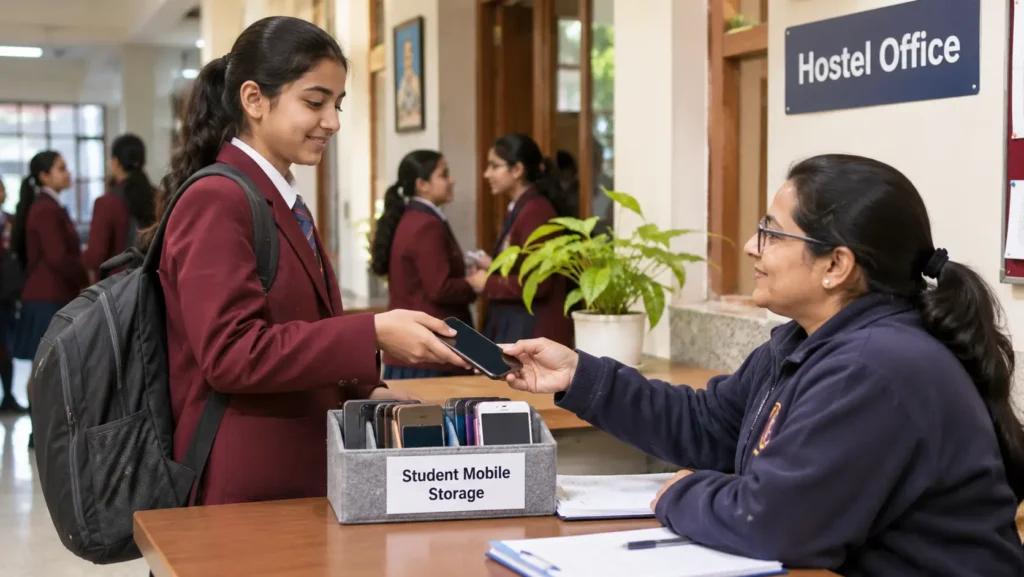
Phone Collection and Storage
Some residential schools collect students’ mobile phones and store them securely.
Devices may be returned during approved communication hours or holidays.
This arrangement helps maintain consistency in the hostel environment.
Social Media Restrictions
Social media platforms can expose students to online distractions, inappropriate content, and privacy concerns.
Schools may establish guidelines regarding Instagram, Facebook, YouTube, messaging applications, and other online platforms.
Parents should understand how these guidelines are communicated and enforced.
Communication with Parents
Schools generally have established communication arrangements for parents and students. These may include scheduled phone calls, official communication channels, or supervised access to telephones.
Parents should also ask about emergency communication procedures.
4. Screen Time Rules for Different Age Groups
A student’s ability to manage digital devices develops with age and experience. Therefore, technology policies should consider individual maturity and educational requirements.
Primary School Students
Younger children generally require greater supervision.
Schools may limit recreational screen access and focus on outdoor games, reading, classroom activities, creative exercises, and social interaction.
At this stage, developing healthy routines is more important than providing unrestricted access to personal devices.
Middle School Students
Middle school students may begin using computers and the internet more frequently for assignments and educational projects.
They can gradually learn about online safety, responsible browsing, and appropriate digital behaviour.
Secondary School Students
Students in secondary classes may require additional access to technology for research, presentations, projects, and examination preparation.
Schools may provide supervised access while maintaining restrictions on recreational usage.
Senior Secondary Students
Older students often have more demanding academic requirements.
They may need digital resources for competitive examination preparation, research, presentations, and subject-specific learning.
Schools may provide greater flexibility while continuing to encourage responsible technology usage.
5. Benefits of Limiting Excessive Screen Time for Students
The objective of managing screen time is not to completely remove technology from students’ lives. It is to ensure that digital entertainment does not replace important educational and developmental activities.
Here are some potential benefits of balanced screen usage.
1. Better time management: Students can organise their daily schedules around classes, homework, sports, and personal activities.
2. Improved concentration: Fewer unnecessary digital interruptions can make it easier to complete academic tasks.
3. More physical activity: Students have additional opportunities to participate in outdoor games, exercise, and sports.
4. Stronger friendships: Face-to-face interactions help students develop communication and teamwork skills.
5. Consistent sleep routines: Reducing late-night recreational device usage can support healthier bedtime habits.
6. Greater independence: Students gradually learn to make responsible decisions without depending on constant supervision.
A balanced approach allows students to benefit from technology without allowing it to dominate their daily routines.
6. How Boarding Schools Balance Technology and Education
Modern boarding schools increasingly recognise the importance of digital education.
Restricting excessive recreational screen usage does not mean avoiding technology altogether. Students still need opportunities to develop digital literacy and technological skills.
Schools may integrate technology through several educational activities.
Smart Classrooms
Digital boards, educational videos, presentations, and interactive learning tools can make classroom lessons more engaging.
Computer Laboratories
Computer laboratories provide students with opportunities to develop computer skills, learn software applications, and understand digital tools.
Digital Learning Platforms
Educational platforms can help students access assignments, study materials, practice exercises, and learning resources.
Research and Online Assignments
Students may use supervised internet facilities to research topics, prepare projects, and collect information for academic presentations.
Digital Safety Education
Students should also understand responsible internet usage, online privacy, password security, cyberbullying, and the importance of avoiding suspicious links.
The right balance between digital learning and offline activities helps prepare students for an increasingly technology-driven world.
7. What Parents Should Ask About Screen Time Rules in Boarding Schools
Before selecting a residential school, parents should discuss technology policies with the admission counsellor or school administration.
Do not assume that all boarding schools follow the same rules.
Here are eight important questions to ask.
Questions Why They Matter
Are personal smartphones permitted? Understand mobile phone restrictions.
How often can students contact parents? Know the communication arrangements.
Is internet access supervised? Understand digital safety measures.
Are laptops allowed? Clarify academic technology requirements.
What are the weekend screen-time rules? Understand recreational access.
Are social media platforms restricted? Learn about online behaviour policies.
Are emergency communication facilities available? Understand how urgent communication is managed.
How does the school address cyberbullying? Evaluate student protection and awareness.
Parents should request written guidelines wherever possible.
A transparent technology policy can help families understand how the school balances student independence, digital access, safety, and discipline.
8. How Students Can Develop Healthy Digital Habits
Students also have an important role in maintaining a healthy relationship with technology.
Even when schools establish restrictions, developing personal responsibility is essential for long-term digital discipline.
Here are some practical habits students can follow:
– Follow device schedules: Use digital devices only during permitted periods.
– Prioritise academic responsibilities: Complete assignments and revision before recreational activities.
– Avoid unnecessary social media: Do not spend every free moment checking notifications.
– Participate in outdoor activities: Make time for sports, exercise, and physical recreation.
– Maintain a healthy bedtime routine: Avoid unnecessary device usage before sleeping.
– Respect school policies: Follow the institution’s mobile phone and internet guidelines.
– Communicate directly: Spend time talking with friends, teachers, and classmates instead of relying entirely on messaging applications.
Developing these habits during school years can help students become more responsible technology users in adulthood.
9. Tips for Parents Before Choosing a Boarding School
Choosing a boarding school involves more than evaluating academic results, infrastructure, and extracurricular facilities.
Parents should also understand how the institution manages students’ everyday digital experiences.
Consider the following factors:
Review the Technology Policy: Ask the school for its latest mobile phone and internet usage guidelines. Understand whether the rules differ between junior and senior students.
Understand Student Supervision: Find out who supervises students during study hours, recreational periods, and hostel activities.
Check Communication Facilities: Ask how frequently students can contact their parents and what arrangements are available during emergencies.
Evaluate Digital Safety: Understand whether the school has policies addressing cyberbullying, online privacy, inappropriate content, and responsible internet usage.
Examine Academic Technology: Check whether students have access to computer laboratories, smart classrooms, and educational digital resources.
Observe the Overall Student Lifestyle: A good residential environment should provide opportunities for academics, sports, creative activities, friendships, personal development, and recreation.
Ultimately, parents should look for a school that encourages responsible independence rather than relying only on strict restrictions.
Frequently Asked Questions (FAQs)
1. Do boarding schools allow students to use mobile phones?
Mobile phone policies vary between boarding schools. Some institutions prohibit personal smartphones, particularly for younger students, while others permit limited usage during designated hours. Parents should confirm the school’s latest policy before completing the admission process.
2. How much screen time is allowed in boarding schools?
There is no single screen-time limit followed by every boarding school. The permitted duration depends on the institution’s policies, students’ age groups, academic requirements, and whether the device is being used for education or entertainment.
3. Why do boarding schools restrict mobile phone usage?
Boarding schools may restrict recreational mobile phone usage to minimise distractions and encourage students to focus on academics, sports, social interaction, and extracurricular activities. These guidelines also help students develop responsible technology habits.
4. Can boarding school students use laptops?
Many schools provide access to computers and digital learning facilities. Some may also permit personal laptops for senior students or specific academic requirements. However, students must follow the institution’s internet access and device usage policies.
5. How can parents communicate with children in boarding schools?
Communication arrangements differ between institutions. Schools may provide scheduled phone calls, supervised telephone access, official communication platforms, or designated parent interaction hours. Parents should ask about regular and emergency communication procedures.
6. Are students allowed to use social media in boarding schools?
Social media access depends on the school’s technology policy and student age group. Some schools restrict social media usage, while others establish supervised access guidelines. Parents should understand how the institution manages online activities and digital safety.
7. How do boarding schools prevent excessive screen time?
Schools may use scheduled device access, supervised computer laboratories, restricted internet networks, mobile phone collection systems, and structured daily routines. Sports, reading, extracurricular activities, and group interactions also encourage students to spend time away from screens.
Conclusion
Technology is an important part of modern education, but students also need time for physical activities, academic development, friendships, and personal growth.
Understanding Screen Time Rules in Boarding Schools helps parents make informed decisions about their children’s residential education. A well-planned technology policy can encourage responsible digital behaviour while ensuring that students have access to useful educational resources.
The goal should not be to eliminate technology but to teach students when, why, and how to use it appropriately.
Before choosing a boarding school, parents should discuss its mobile phone policy, internet supervision, communication arrangements, and digital learning facilities with the admissions team.
A school that balances technology with academics, sports, discipline, and personal development can provide an environment where students learn to become confident, independent, and responsible individuals.