World Space Week: Inspiring Students to Explore Space and Science
The universe has always fascinated young minds. From looking at the Moon and stars to wondering how astronauts live and work in space, children naturally have many questions about what lies beyond Earth.
World Space Week, observed every year from October 4 to October 10, provides schools with an opportunity to turn that curiosity into meaningful learning. It encourages students to learn about space, science, technology, satellites, astronomy, and the many discoveries that have helped us understand our universe.
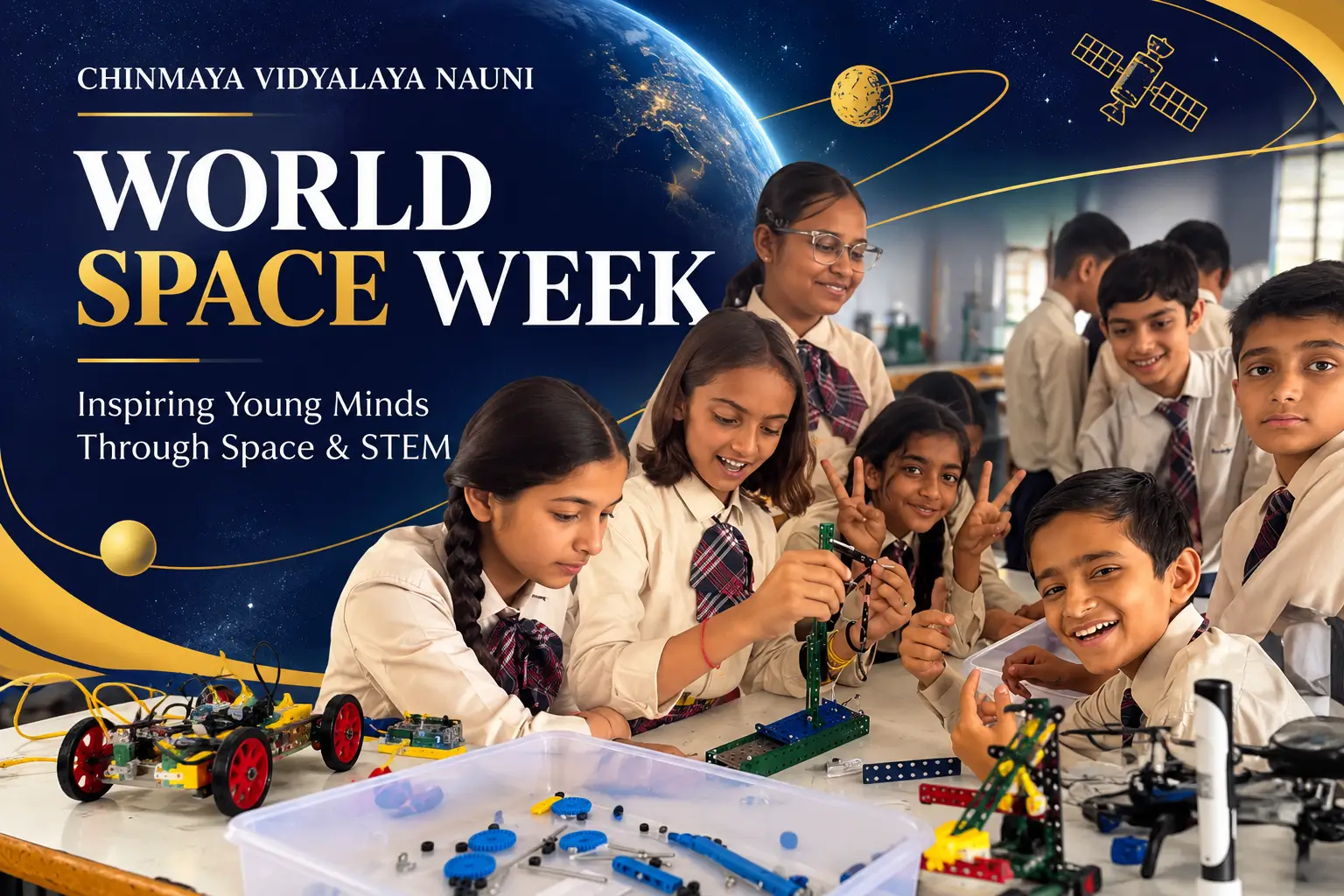
At Chinmaya Vidyalaya Nauni, such occasions can become an important part of learning beyond the regular classroom. Space-related activities can encourage students to observe, question, experiment, and develop a greater interest in science and technology.
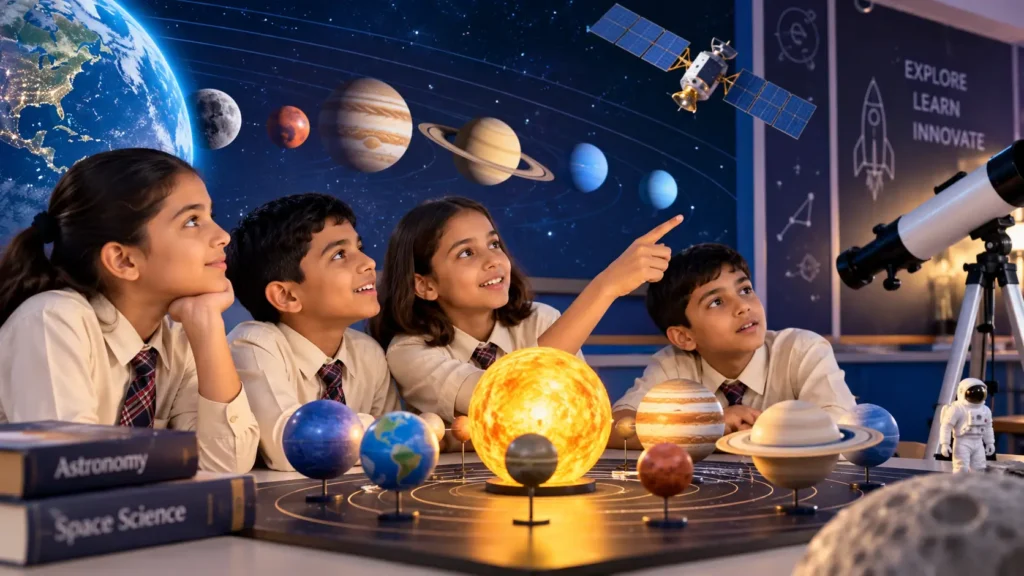
What Is World Space Week?
World Space Week is an annual international celebration of space science and technology and their contribution to human life.
The week begins on October 4, which marks the launch of Sputnik 1 in 1957, the first artificial satellite to orbit Earth. It ends on October 10, the date associated with the signing of the Outer Space Treaty in 1967.
Schools, educational institutions, science organisations, and communities use this week to conduct activities that introduce people to space exploration and its importance. For students, it is a chance to discover how scientific ideas have helped humanity travel beyond Earth and study the universe.
Why Should Students Learn About Space?
Space education is not limited to learning the names of planets or remembering facts about astronauts. It can help students understand how science is applied to real problems. When students learn about space missions, they encounter concepts from physics, mathematics, computer science, engineering, chemistry, and other subjects.
For example, launching a spacecraft involves calculations, engineering design, computer systems, materials science, and careful planning. This helps students understand that different areas of knowledge often work together.
Encouraging Questions
A simple question such as Why does the Moon appear to change shape? can lead to an interesting lesson about the Moon’s movement around Earth. Similarly, questions about rockets, satellites, planets, and stars can encourage students to research topics beyond their textbooks.
Developing Scientific Thinking
Space science gives students opportunities to observe information, compare evidence, make predictions, and understand how scientists reach conclusions. These habits are useful not only in science but also in everyday learning.
Introducing STEM Subjects
Space exploration has a strong connection with Science, Technology, Engineering and Mathematics (STEM).
Students interested in space may discover an interest in subjects such as physics, mathematics, robotics, coding, electronics, engineering, and astronomy.
India’s Contribution to Space Exploration
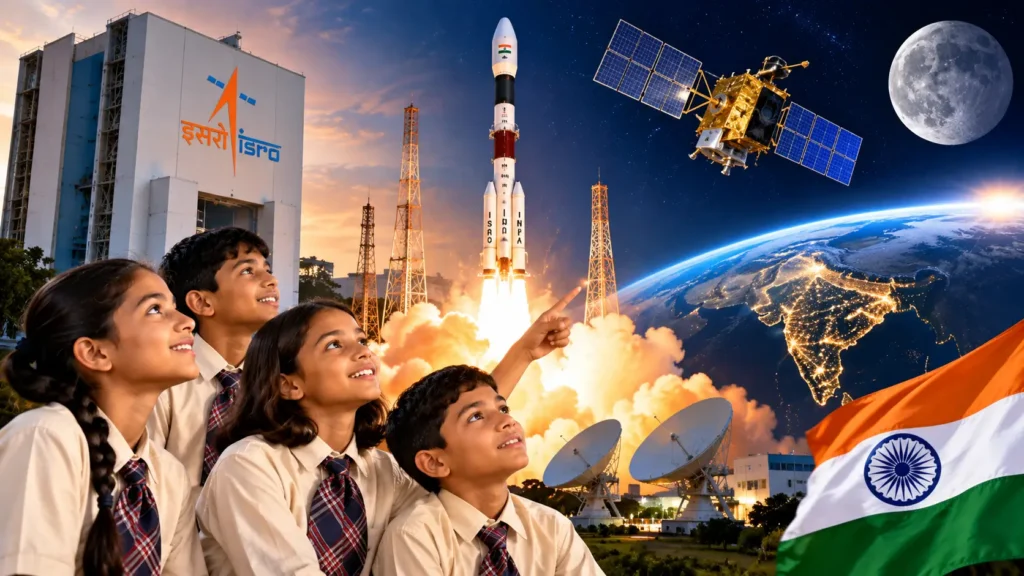
India’s progress in space science provides an important source of inspiration for students. The Indian Space Research Organisation (ISRO) has developed satellites, launch vehicles, and space missions that have contributed to communication, weather forecasting, Earth observation, navigation, scientific research, and exploration.
Indian space missions can help students understand how scientific knowledge, careful planning, teamwork, and technical skills can be used to achieve challenging goals. For young learners, these achievements can also introduce them to possible careers in science, engineering, research, technology, and related fields.
World Space Week Activities for School Students
Schools can celebrate World Space Week through simple and engaging activities. The objective does not always have to be a large event. Even a classroom activity can create interest in space.
1. Space Quiz
A quiz can cover topics such as planets, the solar system, astronauts, satellites, famous space missions, and Indian space exploration.
2. Solar System Model
Students can prepare models of the solar system and learn about the relative positions and movements of planets.
3. Space Poster Competition
Students can create posters on subjects such as space exploration, protecting Earth, future space missions, or India’s achievements in space.
4. Astronomy Session
A teacher or invited expert can introduce students to basic astronomy, including stars, planets, constellations, and the Moon.
5. Science Exhibition
Students can display working models, experiments, charts, and research projects related to space and technology.
6. Space-Themed Storytelling
Younger students can take part in storytelling activities based on astronauts, planets, exploration, and scientific discoveries.
7. Robotics and Coding Activities
Older students can explore how robotics and computer programming are used in space missions and develop simple projects of their own.
| Value | What Students Learn |
|---|---|
| Curiosity | Scientists begin with questions. Encouraging students to ask questions helps them become active learners. |
| Patience | Scientific discoveries often take years of research, testing, and improvement. Students can learn that meaningful results require time and effort. |
| Teamwork | A space mission involves many people working together. Scientists, engineers, programmers, technicians, and other professionals all contribute to the success of a mission. |
| Problem-Solving | Space missions involve many challenges. Finding solutions requires careful thinking, experimentation, and creativity. |
| Responsibility | Studying Earth from space has also helped scientists understand weather, climate, natural resources, agriculture, and environmental changes. This can encourage students to think about their responsibility toward the planet. |
What Can Students Learn From Space Exploration?
Space exploration teaches lessons that extend beyond science.
Creating Interest in STEM at Chinmaya Vidyalaya Nauni
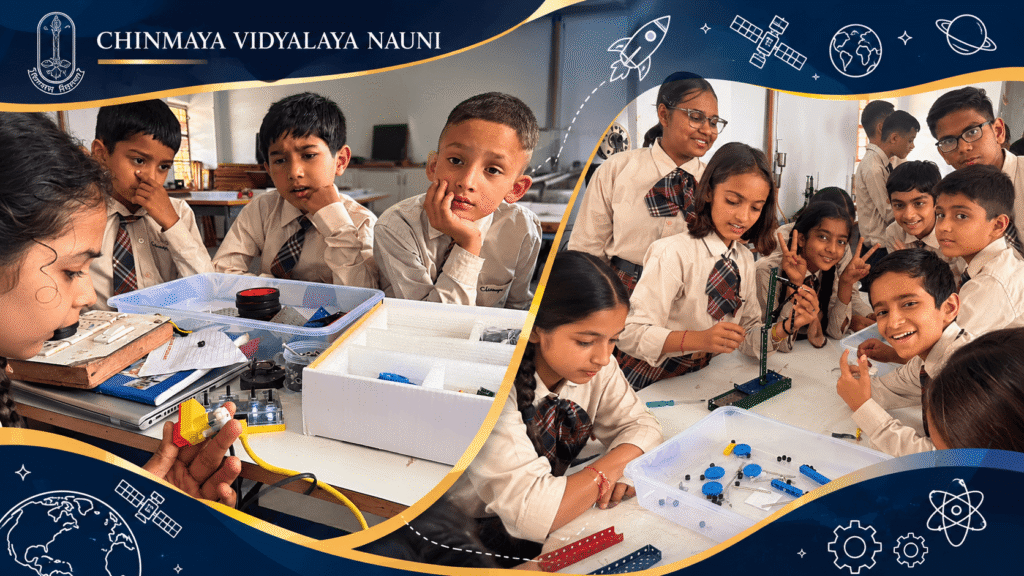
World Space Week can provide students at Chinmaya Vidyalaya Nauni with an opportunity to connect their classroom learning with subjects that have a direct connection to the modern world.
Activities related to space can make science more interactive and give students an opportunity to work on projects, discuss ideas, present their findings, and learn from one another.
Such experiences can also help students identify subjects that genuinely interest them and encourage them to explore those subjects further.
Space Education and the Future
The space sector continues to develop, and future opportunities may extend well beyond traditional careers such as astronomy and aerospace engineering.
Artificial intelligence, robotics, software development, satellite technology, data science, electronics, materials science, and other fields are increasingly connected with space research and exploration.
Introducing students to these areas at an early stage can help them understand how different subjects can lead to exciting career possibilities.
Looking Up and Learning More
A night sky can raise some of the biggest questions a child can ask: How far away are the stars? Are there other planets like Earth?
How were the planets formed? What happens beyond our solar system?
World Space Week gives schools an opportunity to encourage students to explore these questions.
For students at Chinmaya Vidyalaya Nauni, it can be more than a calendar event. It can be an opportunity to develop an interest in science, experiment with new ideas, and understand the role of technology in exploring the world beyond Earth.
The universe is vast, but every discovery begins with a question. By encouraging students to ask those questions, schools can help develop the curiosity that leads to learning, research, and innovation.